
Research
From atomically thin materials, to field-effect transistor biosensors, to point-of-care and on-body health monitoring.
Large-area Epitaxial Growth of van der Waals Materials
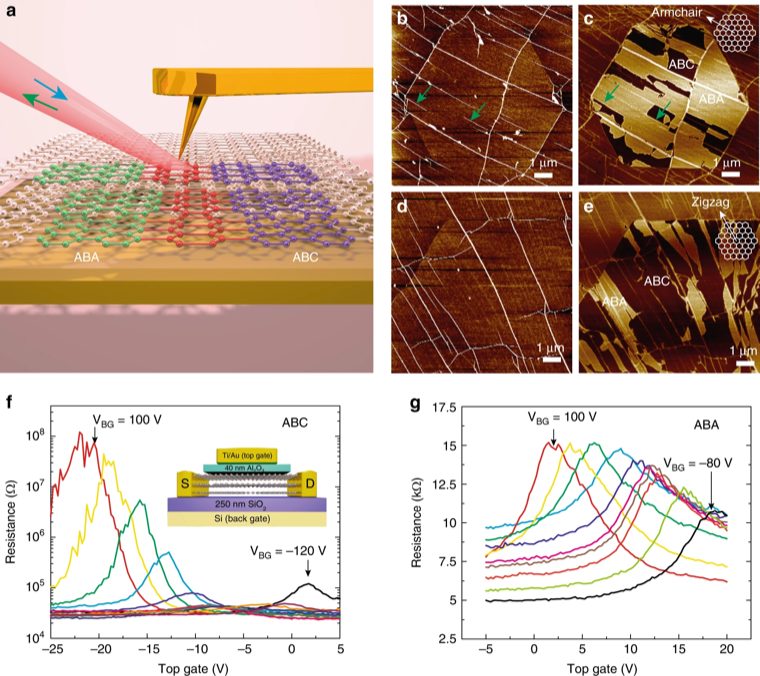
The properties of van der Waals (vdW) materials vary dramatically with the atomic stacking order between layers, yet that order is difficult to control. Trilayer graphene stacks in either a semimetallic ABA or a semiconducting ABC configuration with a gate-tunable band gap — but the latter had only ever been produced by exfoliation. We introduced a chemical vapor deposition (CVD) route to trilayer graphene that greatly enhances the fraction and size of ABC domains. The key insight: substrate curvature stabilizes ABC stacking, reaching controllable ABC yields of ~59%. The ABC fraction survives transfer to device substrates, where transport measurements confirm the expected tunable band gap.
We also demonstrated dense, selective CVD growth of bilayer WSe2 flakes using a sodium cholate / sodium chloride growth promoter to control local diffusion of W-containing species. The as-grown flakes form well-defined monolayer–bilayer junctions with p–n diode rectification and ambipolar transport — an efficient route to layer-controlled 2D transition metal dichalcogenides for next-generation optoelectronics.
Key publications: Nature Communications 11, 546 (2020) · ACS Nano 12, 2275 (2018)
Graphene Field-Effect Biosensor Arrays
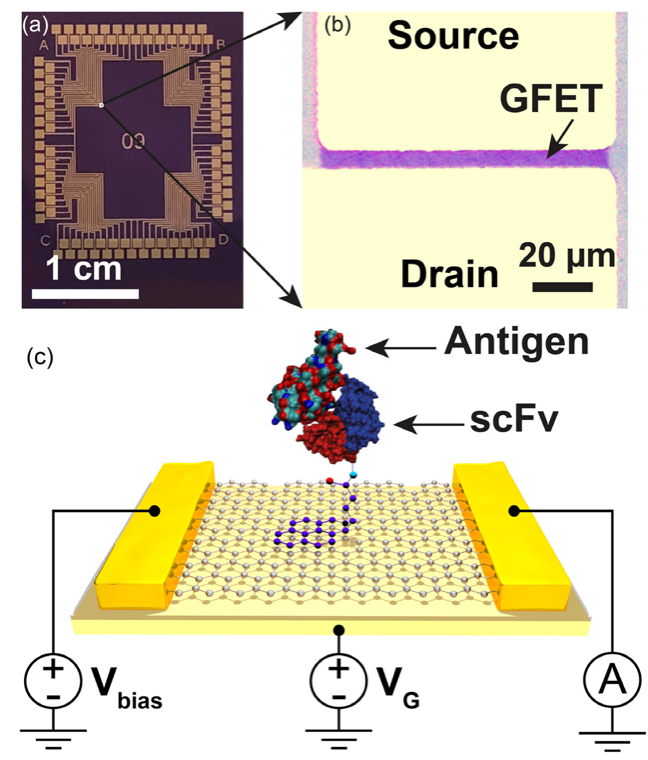
We build scalable graphene field-effect transistor (GFET) biosensor arrays for ultrasensitive, all-electronic detection of disease biomarkers. For Lyme disease, GFETs functionalized with genetically engineered single-chain variable fragment (scFv) antibodies detect Borrelia burgdorferi antigens down to 2 pg mL⁻¹ — a ~4000× improvement over parental IgG antibodies — with multiplexed, site-specific immobilization to reduce false positives.
For nucleic acids, engineered hairpin probe DNA enabling target recycling and hybridization chain reaction pushed the detection limit ~20,000× lower, reaching sub-femtomolar 21-mer DNA with strong single-base-mismatch specificity. We further developed gold-nanoparticle-decorated GFETs with high carrier mobility for robust, label-free assays, and demonstrated rapid miRNA detection via exponential hybridization chain reaction.
Key publications: Nano Letters 18, 3509 (2018) · 2D Materials 7, 024001 (2020) · Biosens. Bioelectron. 266, 116695 (2024)
Wearable Sensors for Real-time Analysis of Human Sweat
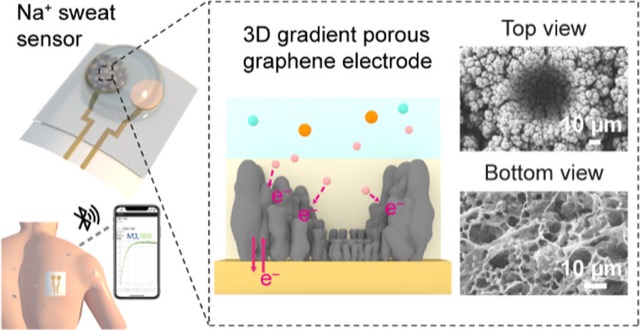
Wearable sweat biosensors are a powerful, non-invasive window onto health and athletic performance. Key sweat biomarkers — electrolytes, metabolites, and hormones — correlate with their blood concentrations and reflect hydration, stress, and physiological state. We develop wearable electrochemical sensors that track these markers continuously and selectively.
Using gradient porous graphene substrates as the solid-contact layer, we substantially enhanced the sensitivity of wearable ion sensors for sweat analysis, enabling stable, real-time monitoring on the body. These platforms target applications across health and wellness, sports science, elderly and infant care, and early-stage disease screening.
Key publications: Nano Letters 22, 6647 (2022) · IEEE Sensors Journal 21, 14522 (2021)
2D Materials for Gas Sensing
Two-dimensional materials expose their entire atomic surface to the environment, making them exceptionally responsive platforms for detecting gaseous analytes. Building on our expertise in scalable CVD growth of graphene, hexagonal boron nitride, and transition metal dichalcogenides, we develop chemiresistive and field-effect gas sensors in which engineered 2D channels and their heterostructures transduce gas adsorption into robust electrical signals.
Our goal is scalable, low-power gas sensor arrays for environmental monitoring, industrial safety, and breath-based health screening, with selectivity engineered through surface functionalization and heterostructure design.